Return to saved papers
Keep the research you chose accessible in your signed-in collection.
Explore Citations
Return to papers you saved and inspect their dated citation records. The actual My papers view below uses invented titles and counts to show how the comparison works.
Saved papers, reading choices and comparison history remain private. The screenshot uses fictional paper records only.
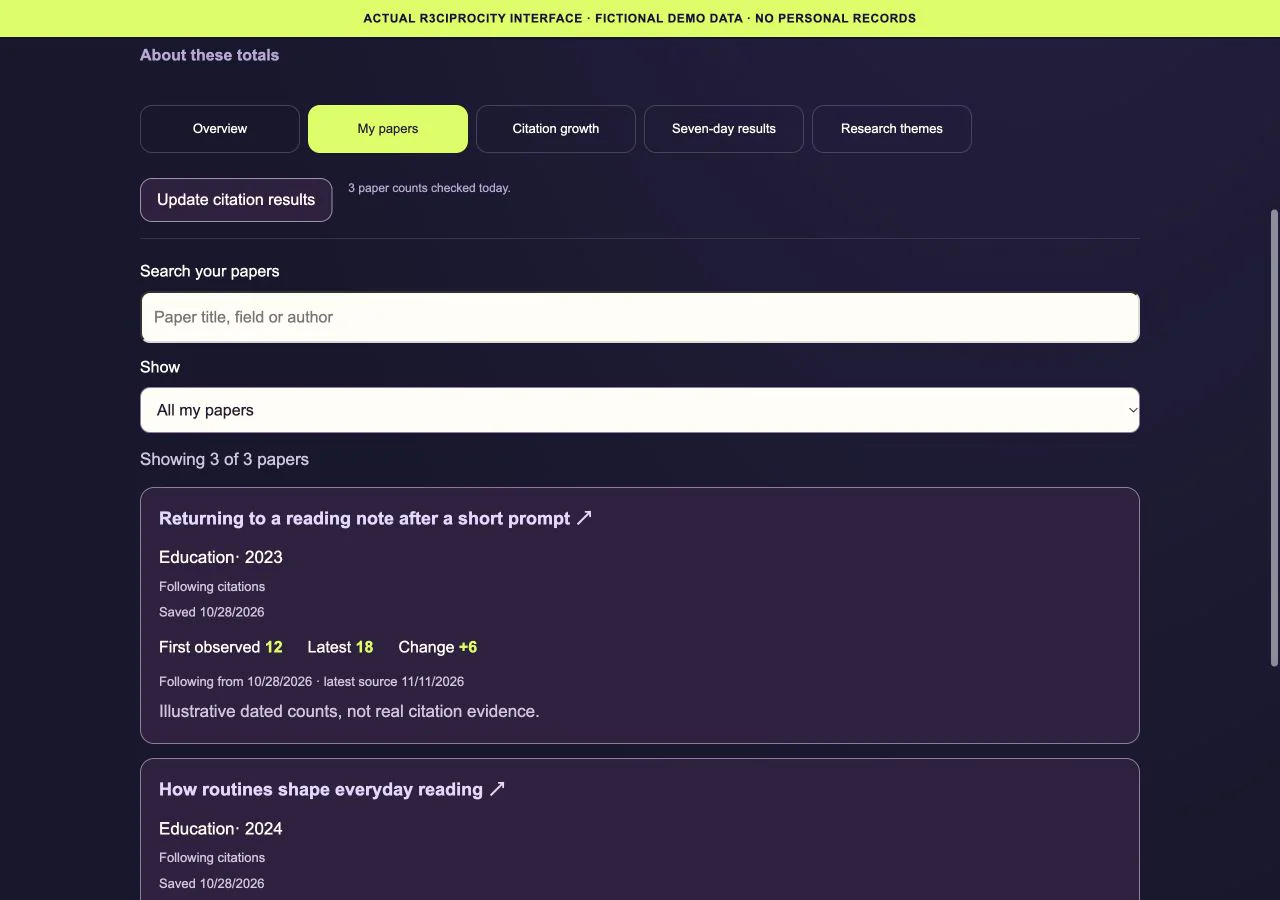
The actual My papers view with fictional records. The displayed dates and counts illustrate the interface; they are not real citation evidence.
Worked example
Invented paper titles, dates and counts. These numbers demonstrate the calculation and are not real citation evidence.
“Returning to a reading note after a short prompt” has 12 first-observed citations and 18 in the later fictional record. The displayed change is 18 − 12 = +6.
The second selected paper changes from 48 to 50 (+2). Its 50 and the first paper’s 18 produce the illustrative total of 68; the dated gains across those two papers sum to +8.
A third paper has no complete dated record. It remains unavailable rather than becoming an invented zero. The example’s 66.7% comparison accuracy is a separate measure from citation growth.
All dates and metrics in the screenshot are fictional, not real citation evidence. A saved paper, a citation guess and a dated citation record describe different things. A larger citation count does not establish which paper is useful for your question or whether anyone agrees with it.
Keep the research you chose accessible in your signed-in collection.
Use source-labelled citation records and retain uncertainty where a history is missing.
Review your citation guesses separately from whether a paper interests you.