Start with your papers
Build your signed-in map around the research you have saved.
Explore Idea-map
Organize saved papers, inspect a possible opening, and choose one source check to make next. This is the actual research-map interface with fictional papers and a provisional lead.
Your papers, map notes and starters stay behind sign-in. This public screenshot is a fixed fictional example.
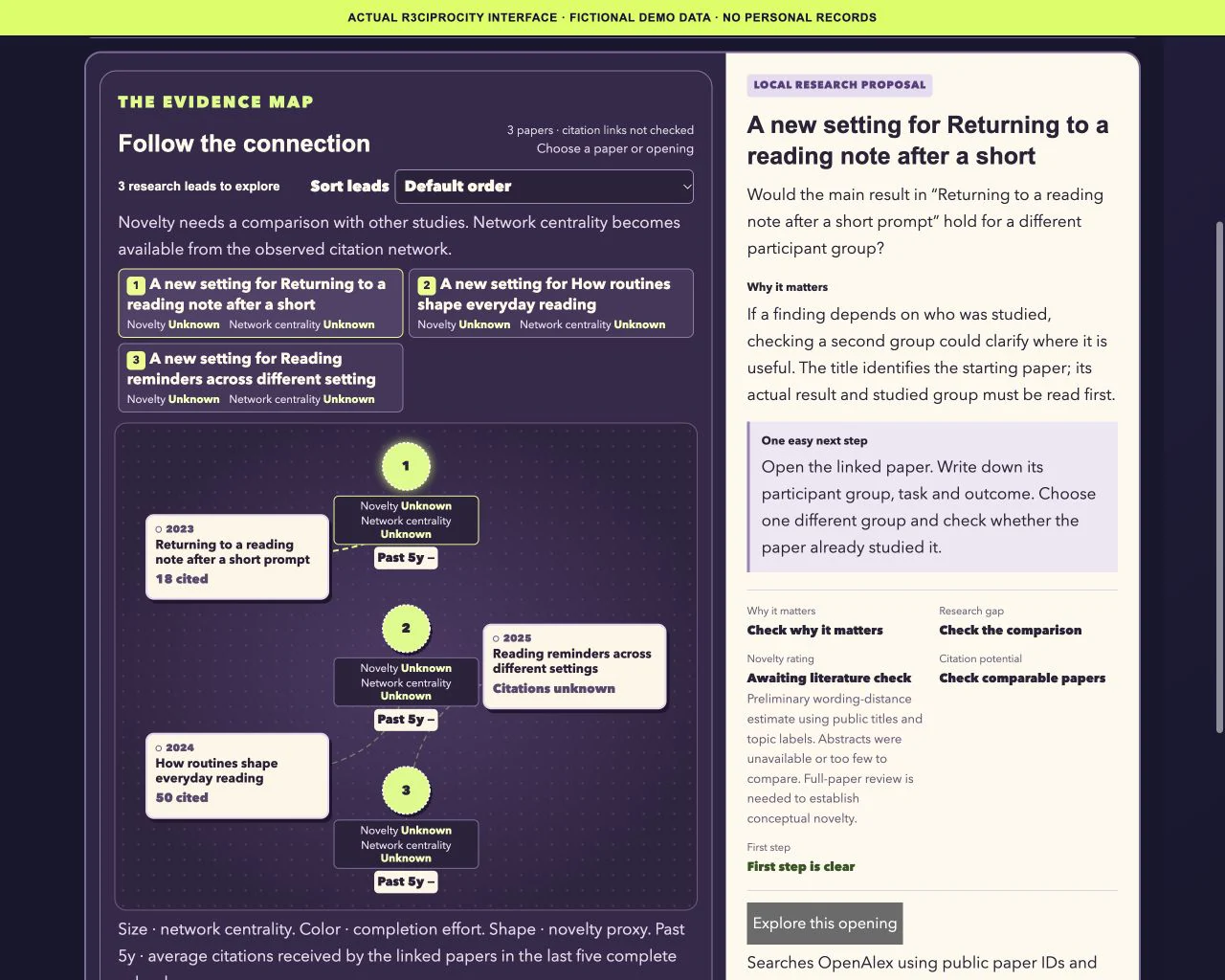
The actual map and opening panel with fictional papers. Unknown novelty and network evidence remain unknown; the proposed lead is not a demonstrated gap.
Worked example
Invented papers and proposals in the actual interface. This is not a map of a user’s saved papers or a verified research gap.
The fictional map contains three papers about reading prompts, routines and settings. Select the lead linked to “Returning to a reading note after a short prompt”.
The opening asks whether the result might hold for a different participant group. Novelty and network centrality remain Unknown because the necessary comparison evidence has not been checked.
Read the source and record its participant group, task and outcome. Check whether it already studied the proposed group before deciding whether there is a useful question to carry into a project.
The actual interface separates a proposed opening from checked evidence. The screenshot uses fictional paper records and leaves missing citation-network and literature evidence unknown. A missing link or a suggested new setting does not prove novelty, an unstudied population or a research gap.
Build your signed-in map around the research you have saved.
Compare topics and methods before treating two ideas as connected.
Keep an opening as a private starter and decide what evidence would help next.